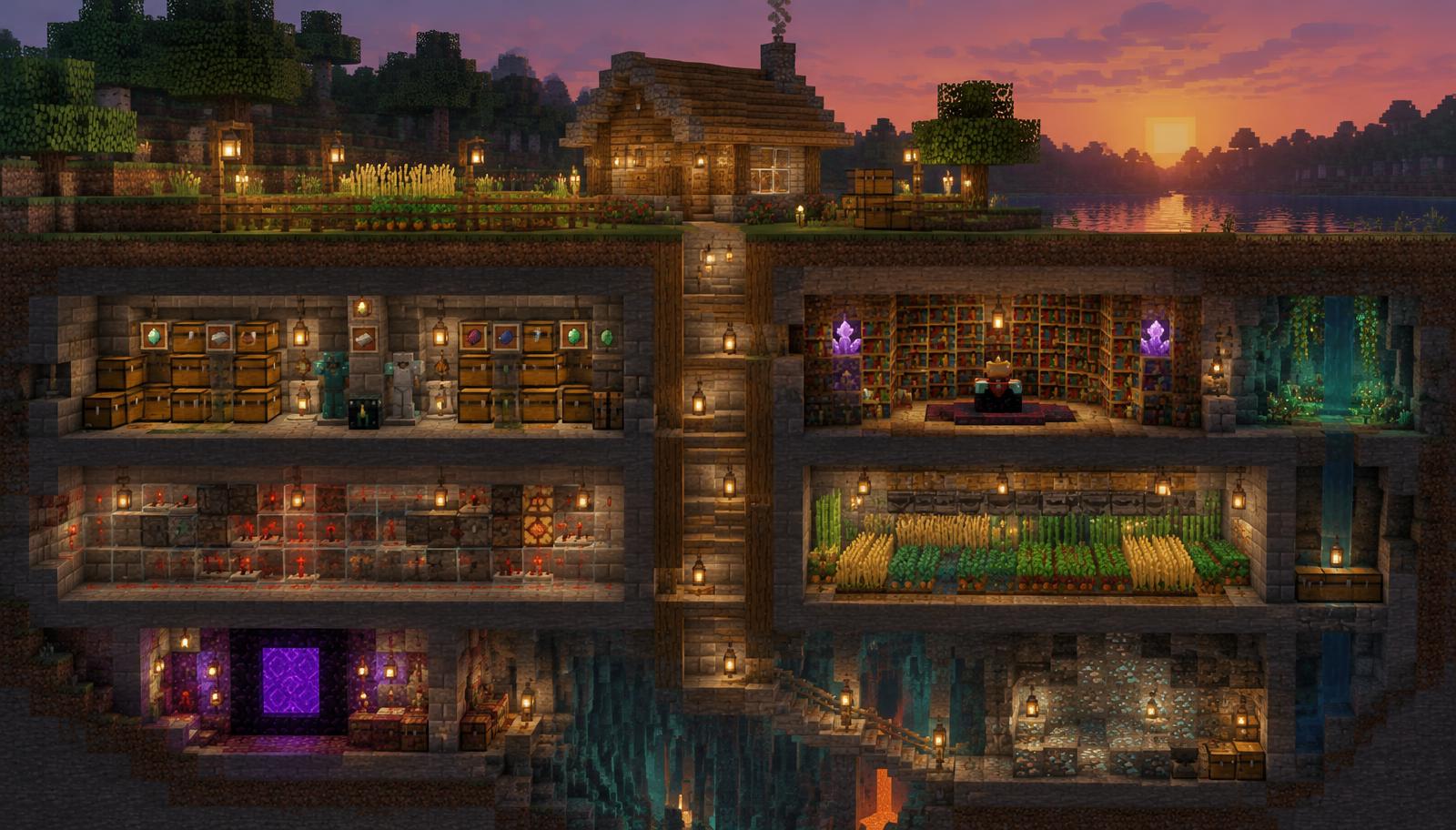
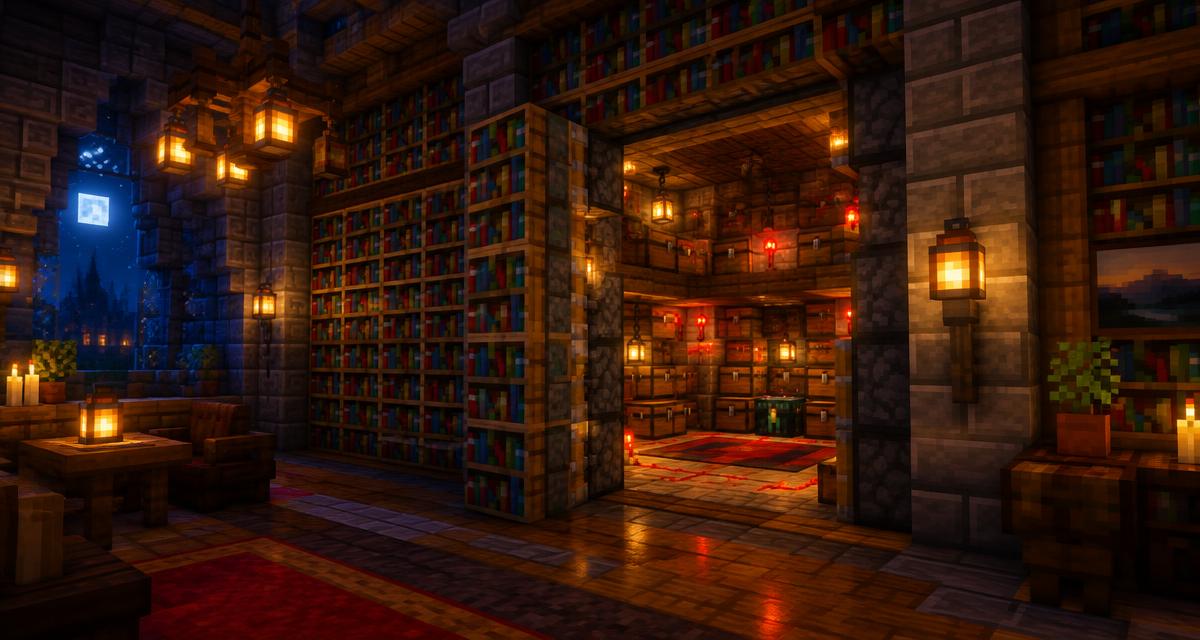
Short answer: the hardest Minecraft secret rooms to find hide in plain sight. They use blocks that already belong in the scene, entrances that need an unusual action (placing an item, reading a lectern, standing in an exact spot), and no visible redstone, sounds or light leaks. Below are 25 secret room designs ranked roughly from easy to expert, with how each one works, why players miss it, and how to build it in Java or Bedrock.
What makes a Minecraft secret room almost impossible to find?
Players find hidden rooms through four clues: odd block patterns, visible redstone, sounds such as pistons and dispensers, and light or particles escaping through gaps. A great hidden room removes all four. Pistons make a distinct sound in both editions, so quieter tricks (trapdoors, signs, paintings, water and scaffolding) often beat large piston doors for secrecy.
- Blend: the entrance uses the same blocks, textures and symmetry as the room around it.
- Silence: fewer pistons and dispensers, or mechanisms placed far from the entrance.
- Darkness: mob-proof the room with non-spawnable blocks instead of torches that leak light.
- Unusual trigger: a specific book page, item frame rotation or pressure plate under a carpet.
25 Minecraft secret rooms ranked from simple to expert
1. The bookshelf piston door
Two sticky pistons push a 1x2 column of bookshelves into the wall. Hide the trigger as a button on the back of a lectern or under a carpeted pressure plate. Bookshelves are the classic disguise because libraries repeat them, so a moving pair is hard to spot.
2. Lectern page lock
A comparator reads a lectern and outputs a stronger signal on later pages. Wire a comparator so the door only opens when the book sits on one exact page. Visitors flip books without ever landing on the right number.
3. Item frame combination lock
A comparator behind an item frame outputs a signal from 1 to 8 depending on the item's rotation. Require a specific rotation (or several frames at once) to open the door. It looks like decor, which is why almost nobody tests it.
4. Painting over a doorway
Paintings do not block movement, so a painting placed over an open 1x2 or 2x2 gap hides a walkthrough doorway. Place signs on the floor of the hole first so the painting has something to sit on. Pick a painting size that matches the wall pattern.
5. Waterfall wall entrance
A flowing water curtain hides a cave tunnel behind it. Players treat waterfalls as scenery. Use stone that matches the cliff and keep the tunnel unlit near the opening.
6. Hidden staircase under a trapdoor floor
Open trapdoors set against blocks look like normal wall trim, and closed trapdoors look like flooring. Build a staircase down beneath a section of trapdoor floor and match its wood type to the rest of the room.
7. Bed or furniture flip door
Put a drop shaft under a fake piece of furniture built from slabs and trapdoors. A hidden lever on the side opens the trapdoor 'cushion' and players fall into a water-cushioned room below.
8. Fireplace escape
A campfire or fake fire on netherrack sits in a fireplace. Pistons retract the hearth blocks and extinguish the fire with a water drop or by pulling the netherrack away, revealing a passage. Fireplaces are scary to step into, so people do not inspect them.
9. Flower pot or composter switch
Comparators can read containers, including composters, chests and many other blocks. Wire the door to a comparator that reacts when a composter reaches a certain fill level or a chest holds a specific item count.
10. The fake chest wall
A row of chests with one entry that is actually a trapped chest. Trapped chests output a redstone signal when opened, so opening the third chest from the left opens a door elsewhere in the room. Nobody suspects storage.
11. Floor-level 1x1 crawlspace
Since the Village and Pillage era, trapdoors can make players crawl in Java. Hide a 1 block tall tunnel behind a closed trapdoor at floor level and continue it under the floor. Bedrock handles crawling differently, so test there before relying on it.
12. Scaffolding chimney
Scaffolding lets you climb up and sneak down. Put a scaffolding column inside a chimney or hollow tree trunk with a small blocked top, so the route only works if you know to climb inside.
13. Sea lantern pond room
An underwater room beneath a garden pond, entered by swimming through a kelp patch. Use doors or signs to make an air pocket entrance. Kelp and seagrass hide the opening from above.
14. Hollow tree trunk elevator
Build a large fake tree out of logs and leaves with a ladder or bubble column inside. A soul sand bubble column pushes players up and magma blocks pull them down, giving a fast, silent elevator.
15. Observer-triggered secret door
Observers detect block updates. Hide an observer behind a decorative block that changes state, such as a lamp, crop or note block. Changing that block opens the room, while the observer stays buried.
16. Hidden room behind an ender chest
Breaking an ender chest without Silk Touch drops obsidian, so players rarely mine one. A trapdoor or doorway hidden right behind a base ender chest stays almost untouched.
17. Piston floor drop
A 2x2 floor of sticky pistons pulls blocks down into a hidden staircase. Hide the input as a tripwire hook string under carpet. Keep the circuit wiring several blocks away to reduce noise near the entrance.
18. Armor stand vault
An armor stand on a pressure plate stands in front of a wall. Moving the stand off the plate breaks the signal and opens a door. Armor stands and decorative armor look entirely ordinary.
19. Sculk sensor sound door
Sculk sensors detect vibrations. Hide one behind solid blocks with wool around it to limit what it hears, and trigger it with a specific action near the entrance. Calibrated sculk sensors in recent Java versions can filter for particular vibration frequencies.
20. Glass ceiling illusion room
Put a hidden room above a high ceiling covered in matching blocks, entered by an ender pearl throw or a hidden ladder in a pillar. Players look along walls, rarely up.
21. Nether portal secret base
A room hidden behind an inactive portal frame, or a Nether-side bunker built at the exact matching coordinates. Use Nether coordinates divided by 8 so the room sits near a portal only you know how to link.
22. Map-wall entrance
Item frames with maps fill a wall. One section of frames is mounted on a sticky piston block, which moves when activated. Many map wall builds already have depth, which hides the gap.
23. Lava curtain vault
Lava behind glass or iron bars looks dangerous and decorative. A hidden piston or dispenser and bucket removes the flow when the code is entered. Treat it as an advanced, Java-tested build, because fluid behaviour differs.
24. Redstone vault with multiple steps
Combine three triggers in sequence: a lectern page, an item frame rotation, and a pressure plate. Use comparators and an AND gate so all must be correct. This is the most robust lock for multiplayer servers.
25. The underground city entrance
A full village or city hidden below a normal surface house, entered through a sequence of the above tricks. Plan it in layers: surface decoy, secret entrance, transit level, then the real base.
How to stop players from finding your secret room
- Remove light leaks and stop torches from giving away hollow walls.
- Keep pistons and observers away from the doorway or behind dense blocks.
- Avoid unique blocks only used near the entrance.
- Test it in survival with a friend who did not watch you build.
- On servers, remember that admin tools, spectator mode and x-ray mods can reveal any room; protect valuables with server permissions, not only with hiding.
Java vs Bedrock differences for secret rooms
Redstone behaves differently between editions. Java has quasi-connectivity, which some compact piston doors rely on, while Bedrock does not. Bedrock pistons also have different timing. Build and test door designs in the edition you play, and use designs labeled for your edition.
Plan your secret room before you build
Use the MineBuildr Redstone Designer to sketch the circuit, the House Planner to fit the room inside a normal-looking home, and the Schematic Viewer to check a downloaded design before importing it.
Sources
- Minecraft Wiki, Redstone circuits: https://minecraft.wiki/w/Redstone_circuits
- Minecraft Wiki, Comparator (lectern, item frame and container outputs): https://minecraft.wiki/w/Redstone_Comparator
- Minecraft Wiki, Piston and quasi-connectivity: https://minecraft.wiki/w/Piston
- Minecraft Wiki, Sculk Sensor: https://minecraft.wiki/w/Sculk_Sensor
- Minecraft Wiki, Bubble Column: https://minecraft.wiki/w/Bubble_Column
- Minecraft.net official site: https://www.minecraft.net
Give your next ambitious build a better workflow
A dependable network starts with a clear plan. Keep the surrounding build organized with Premium, from the first terminal room to your next server project.
- Saved Workshop projects to return to as your design evolves
- Priority AI generation for build concepts and material planning
- Supported schematic and HD / 4K exports
- Advanced server tools for configuration and permissions
Compare current prices and billing options before checkout. Features depend on the tool and export format. Premium does not provide internet connectivity or certify redstone circuits. Core tools remain free. Review the Terms and Refund Policy.