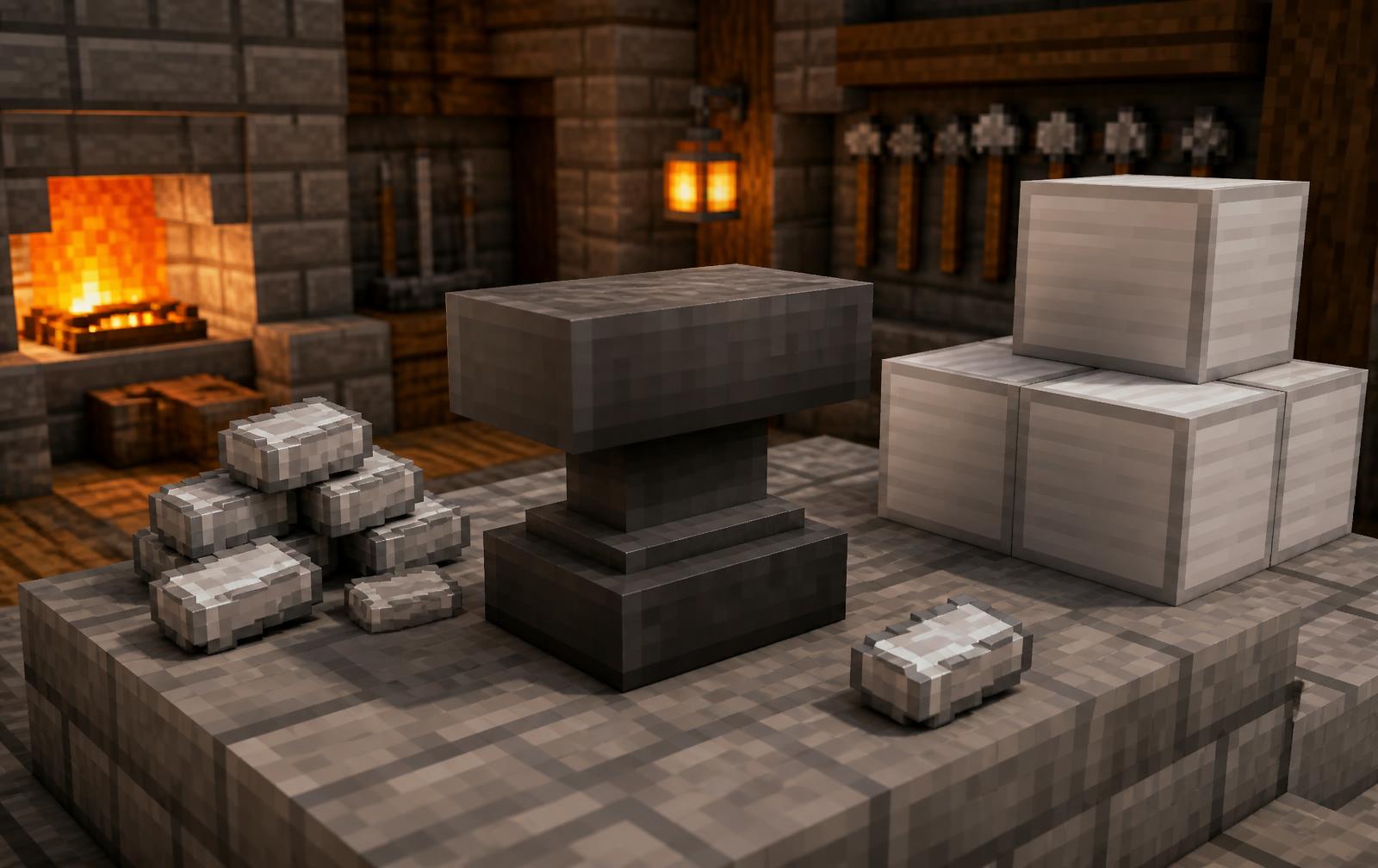
Minecraft anvil recipe
The anvil is a 3x3 recipe, so it needs a crafting table. The shape is fixed and no substitutes work — only iron blocks and iron ingots.
- Mine iron ore or deepslate iron ore with a stone pickaxe or better.
- Smelt the raw iron in a furnace or blast furnace to get iron ingots.
- Craft 3 blocks of iron by filling a crafting grid with 9 ingots each (27 ingots).
- Open a crafting table and place the 3 iron blocks across the top row.
- Put 1 iron ingot in the centre square of the middle row.
- Put 3 iron ingots across the bottom row.
- Take the anvil and place it where you want your repair station.
Total cost: 31 iron ingots. That is roughly one full survival mining trip through a deepslate layer, or a couple of hours from an iron farm. If you want the fastest route to that iron, the iron farm planner sizes a village-based farm around your rates.
Where to find an anvil without crafting one
- Woodland mansions generate anvils in blacksmith-style rooms — see the woodland mansion finder to locate one on your seed.
- Village weaponsmith and toolsmith houses often contain a usable anvil you can mine with any pickaxe.
- Some village armorer buildings include an anvil next to the smithing setup.
- Anvils are the only way for a non-librarian world to apply enchanted books, so grabbing a village anvil early is a real time saver.
Break an anvil with a pickaxe and it drops itself, keeping its damage state. Break it with anything else and it drops nothing.
What an anvil actually does
- Repair — combine a damaged item with the material it is made from, or with a second copy of the same item.
- Rename — type a new name into the text field for 1 level. Renamed items keep the name forever, and a renamed name tag can label a mob.
- Apply enchanted books — the only way to move a book enchantment onto gear.
- Combine enchantments — merge two enchanted items of the same type into one with the higher levels.
- Keep enchantments while repairing — unlike a grindstone, the anvil preserves enchantments, and a grindstone strips them.
- Repair items with Mending faster than waiting for XP orbs when you have spare materials.
How anvil XP costs work
Every anvil action has a level cost shown at the bottom of the interface. The cost is the sum of the enchantment costs, the rename cost, the repair cost, and the prior work penalty on both items.
- Repair with materials costs 1 level per ingot or unit used, up to 4 units.
- Renaming costs 1 level on top of everything else.
- Each enchantment transferred costs levels based on its rarity multiplier and level.
- The prior work penalty is 2 to the power of the number of previous anvil uses, minus one — so 1, 3, 7, 15, 31 and so on.
- Survival mode refuses any operation over 39 levels and shows Too Expensive. Creative mode ignores the cap.
You still need the levels to spend them, so pair your anvil work with a fast XP source. The XP calculator converts mob kills and ore into levels, and the XP farm calculator sizes a farm that keeps up with your repair habit.
How to avoid Too Expensive
Too Expensive is almost always caused by the prior work penalty stacking, not by the enchantments themselves. Order of operations is everything.
- Combine books with books first. Merging two Sharpness IV books into a Sharpness V book is cheap while both books have low prior work.
- Build one final book that carries every enchantment you want, then apply it to fresh gear in a single anvil use.
- Apply the most expensive enchantment last is a myth — apply the combined book first, while the gear has zero prior work.
- Rename the item at the same time as the last enchantment step instead of as a separate use.
- Never repair gear with materials before enchanting it, because each repair bumps the penalty.
- If an item is already maxed out on penalty, put Mending on it and stop using the anvil for repairs entirely.
Choosing which enchantments are worth the levels is its own decision. Our guides to the best sword enchantments and the best armor and sword enchantments rank them by real survival value, and the enchanting calculator shows the level costs before you commit.
Why anvils break and how to make them last
An anvil has 25 uses on average. Each use has a 12 percent chance to damage it, and there are three states before it is destroyed.
- Anvil — undamaged, the state you craft.
- Chipped anvil — visible cracks, works identically.
- Damaged anvil — heavier cracks, still works identically.
- Destroyed — the block disappears with a breaking sound and drops nothing.
- Damage state has no effect on cost or function, only on how many uses remain.
- Falling an anvil onto a block also has a chance to damage it, so avoid using your good anvil as a trap component.
- Anvils cannot be repaired. Craft a new one, which is why an iron farm matters if you enchant often.
- Keep a spare anvil in your enchanting room so a break never interrupts a build session.
Anvils as falling blocks and traps
- Anvils obey gravity like sand and gravel, so they fall when the block beneath is removed.
- A falling anvil deals 2 damage per block fallen, up to 40 damage, halved by a helmet.
- Dropping an anvil is a classic mob-trap finisher and a fast way to break a specific block from above.
- A falling anvil that lands on a non-solid block simply drops as an item, so it is easy to recover.
- Redstone-triggered anvil drops work well in the traps you can plan with the redstone designer.
Common anvil mistakes
- Trying to craft an anvil with 4 iron ingots and 3 iron blocks in the wrong rows. Blocks go on top, ingots on the bottom, one ingot in the centre.
- Using the 2x2 inventory grid. The anvil needs a crafting table.
- Combining items in the wrong slot order. The left slot is the item you keep, the right slot is sacrificed.
- Repairing enchanted gear with a grindstone. It works but strips every enchantment.
- Enchanting piecemeal, one book at a time, until the penalty pushes you past 39 levels.
- Placing the anvil somewhere it can fall, then losing it to a chunk edit or a mined support block.
Related guides and tools
Pair this with how to make a shield in Minecraft for gear you will repair often, bookshelves for max enchantment for your enchanting setup, and the enchanting calculator for exact level costs.