If you've ever stood next to a lonely enchanting table watching it offer level 4 enchantments while you've got a stack of diamond gear in your inventory, you know the frustration. The fix is bookshelves — and the magic number is 15. This guide breaks down exactly where to put them, what they cost, and the two rules players still get wrong in 2026.
The short answer
Why 15 bookshelves?
The enchanting table caps at 15 "bookshelf power." Each bookshelf within range and unblocked contributes 1 power. At 15 power, the third enchantment slot is guaranteed to roll up to level 30. Below 15, the cap scales down linearly — 8 bookshelves caps you at level 15, 0 bookshelves caps you at level 8. The 16th bookshelf onward is purely decorative.
The exact bookshelf layout
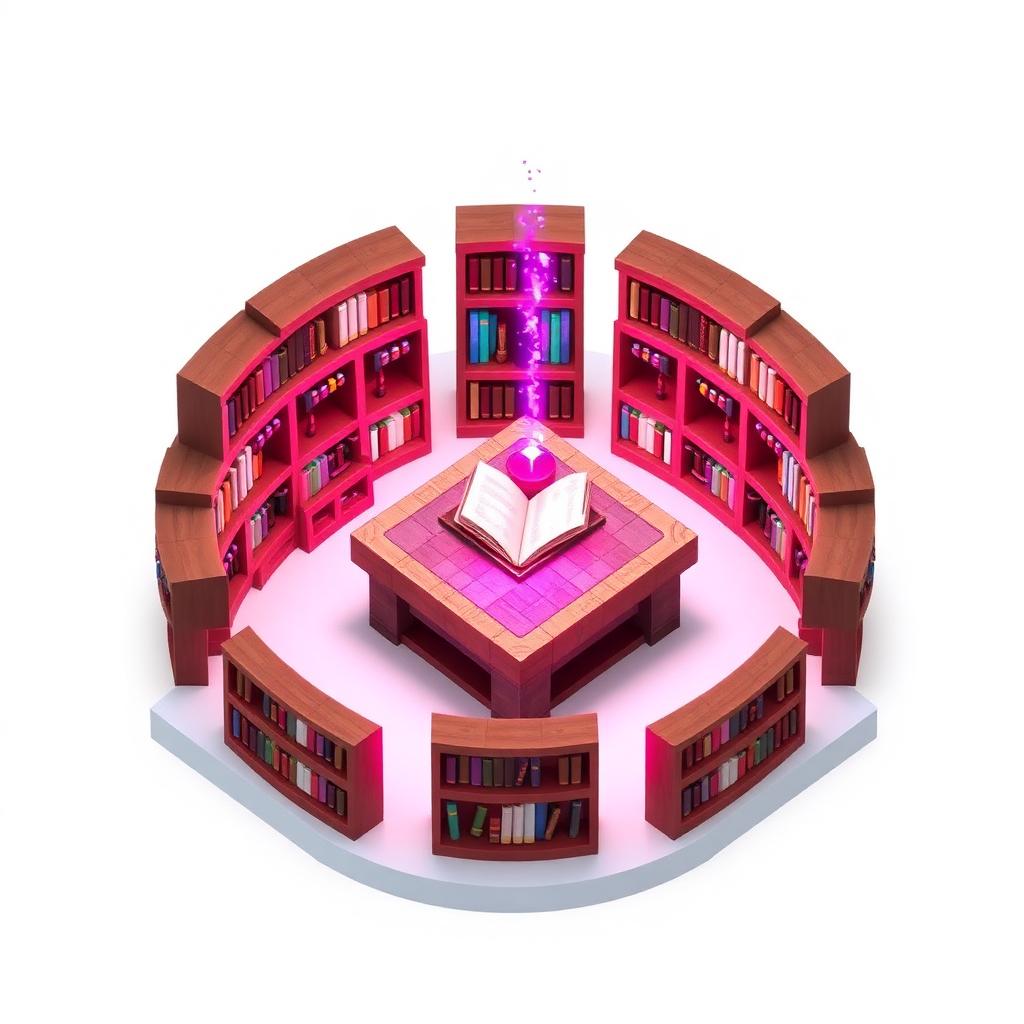
The optimal placement is a 5×5 square ring around the enchanting table, with the table in the center of an empty floor:
- Place the enchanting table in the middle of a 5×5 area.
- Leave a 1-block air gap on all four sides of the table.
- Place bookshelves along the outer ring at the same Y level as the table — that's 8 bookshelves.
- Add a second ring of bookshelves directly above the first — 7 more bookshelves (you can skip one corner or any block, since 15 is the cap).
The exact arrangement doesn't matter as long as the bookshelf is within a 5×5×2 cube around the table and the line between bookshelf and table is unobstructed. Even diagonal bookshelves count.
The two rules players still get wrong
Rule 1 — Keep one block of air between table and bookshelf
If a bookshelf is touching the enchanting table, it does NOT count. There has to be exactly one block of air between them. This is the single most common mistake — every time you see a screenshot of a 15-bookshelf setup that's only giving level 12, this is why.
Rule 2 — Don't block the line of sight
If any solid block sits between a bookshelf and the table — a torch on the side, a carpet, a button, a slab at the wrong height — that bookshelf is ignored. Half-slabs, fences, and even soul sand block it. Keep the gap empty: use floor torches or place lighting outside the bookshelf ring.
Material cost for the full setup
Each bookshelf is crafted from 6 wood planks and 3 books. Each book is 3 paper + 1 leather. So 15 bookshelves cost:
- 90 wood planks (~12 logs)
- 45 books = 135 paper + 45 leather
- 135 paper = 135 sugarcane
- 45 leather — usually the bottleneck (~15 cows or a Leatherworker villager)
If you have a Librarian set up, buying bookshelves directly is often cheaper — a Journeyman Librarian sells bookshelves for 9 emeralds each. See our full villager trading guide for the fastest way to set this up.
Lapis lazuli and XP costs per enchant
Even with a perfect 15-bookshelf setup, each enchantment still costs:
- 1–3 lapis lazuli per enchant (3 for a level 30 slot)
- 1–3 XP levels consumed (the table shows a level 30 cost, but only deducts 3 actual levels — you still need to BE level 30 to use that slot)
Plan your XP routes around this — the fastest XP methods guide covers the most efficient ways to get to level 30 quickly.
Does this work the same in Bedrock?
Yes. Since the 1.20 enchanting parity update, Bedrock and Java use the same 15-bookshelf cap, the same 1-block gap rule, and the same line-of-sight rule. Bedrock had a slightly different roll table historically, but the bookshelf math is now identical.
What about the enchanted book trick?
Some players skip the enchanting table entirely and farm enchanted books from Librarian villagers, then apply them with an anvil. This costs more XP per enchant but lets you target exact enchants like Mending or Sharpness V without rolling. The two strategies complement each other — use the table for general gear, librarians for specific high-value enchants.
Build the table once, build it right, and you'll enchant every piece of gear in your world from the same setup. Then graduate to a trading hall for the books the table won't roll.