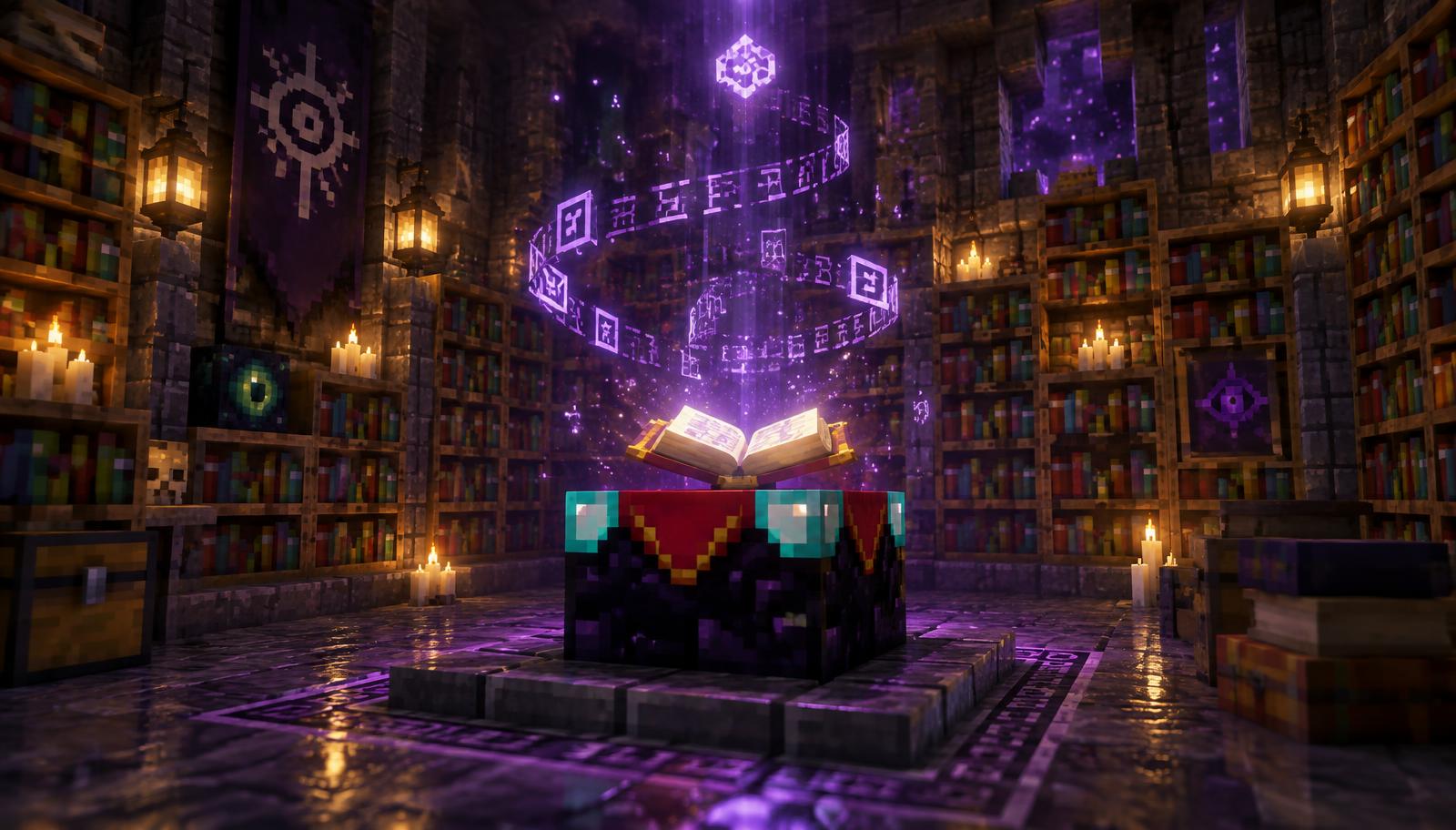
Every player has stared at those glowing purple squiggles above an enchanting table and wondered whether they mean anything. They do — just not what most people hope. The enchanting table language is a straight letter-for-letter cipher of English called the Standard Galactic Alphabet, and once you know the key you can read every word the table shows. This guide gives you the full alphabet, the complete phrase pool, and the honest answer on whether the words matter.
The short answer
What is the Standard Galactic Alphabet?
The Standard Galactic Alphabet, usually shortened to SGA, first appeared in Commander Keen: Invasion of the Vorticons, an id Software platformer from 1991. In that game the alien signage was written in a custom 26-glyph font that mapped directly onto the English alphabet, so players could decode messages on walls and signs.
Mojang reused that same font for the enchanting table interface in Minecraft 1.3. Because it is a font and not a language, the underlying text is ordinary English or Latin-flavoured nonsense — the game simply draws each character with an alien-looking glyph.
How to read the enchanting table alphabet
Each glyph corresponds to exactly one letter, so decoding is a lookup, not a puzzle. Learn these landmarks first and the rest fall into place quickly:
- A is a small open square with a stem — the most common glyph in any phrase, which makes it a great anchor.
- E is a tall vertical bar with two short arms on the right, and it appears in almost every word.
- I is a single short vertical stroke with a dot-like cap, the simplest glyph in the set.
- O is a rounded loop, one of the few curved shapes in an otherwise angular alphabet.
- T is a cross-shaped glyph with an extended lower stem.
- S is a zigzag of three connected strokes, easy to spot at the start of the elder scrolls phrases.
The alphabet contains no separate glyphs for numbers or punctuation in the enchanting table UI, and the table never renders capital letters differently. Spaces are ordinary gaps, so word boundaries are visible at a glance.
Every phrase the enchanting table can show
The table pulls words at random from a fixed pool. The pool is a mix of H. P. Lovecraft's Cthulhu Mythos, the Klaatu barada nikto line from The Day the Earth Stood Still and Army of Darkness, and Elder Scrolls references. Common entries include:
- the elder scrolls
- klaatu berata niktu
- xyzzy
- cthulhu fhtagn
- phnglui mglw nafh
- rlyeh wgah nagl fhtagn
- ia ia
- nether portal, creeper, enderman, sniffer and other Minecraft mob and block names
- elder guardian, phantom, warden and similar in-game nouns
- grumm, embiggen, twisted, gargamel, hupzuq and other joke entries
Words are combined at random, so you will regularly see phrases that read like nonsense even after decoding. That is intentional flavour text, not a code with a hidden meaning.
Do the words affect your enchantment?
No. This is the single biggest myth about enchanting. The glyph text is drawn from a random pool with no link whatsoever to the enchantment the slot will produce. The only real information the interface gives you is:
- The XP level requirement shown on the right of each slot.
- The lapis lazuli cost, which is 1, 2 or 3 depending on the slot.
- One enchantment name revealed in the tooltip when you hover the slot — usually not the full result.
Everything else is decided by a seed the game reroll when you enchant an item. If you want to control what you get, the reliable route is targeted enchanted books from Librarian villagers, covered in our villager jobs and trades guide.
Getting the most out of the table
Since the words are cosmetic, the useful levers are your bookshelf count, your XP level and your lapis supply:
- Place exactly 15 bookshelves to unlock level 30 slots — see how many bookshelves for max enchantment for the exact layout.
- Get to level 30 before you touch the table. The fastest XP methods guide covers the quickest routes.
- Stock at least a stack of lapis lazuli — top slots cost 3 each and reroll costs add up.
- Enchant a cheap book or stone tool first to burn off a bad seed before enchanting diamond or netherite gear.
- Check the best enchantments guide so you know which rolls are worth keeping.
Can you write in the enchanting table language?
In vanilla Minecraft you cannot type SGA into a book, sign or chat and have it render as glyphs — the game only applies that font inside the enchanting table interface. Players who want SGA text in their worlds use one of these routes instead:
- A resource pack that swaps the default font for the SGA font, which converts all in-game text at once.
- A custom font in map-making projects using the font key in raw JSON text components.
- Rendering the text outside the game as an image, then importing it as pixel art or a custom banner for signage.
For decorative builds, an SGA-styled banner above your enchanting room reads as authentic wizard-tower detailing without touching any files. Our banner generator handles the layer stacking for you.
Java and Bedrock differences
Both editions use the same Standard Galactic Alphabet font and the same random phrase behaviour in the enchanting table. Bedrock's phrase pool is very slightly smaller, and some Bedrock devices render the glyphs a touch thinner at low GUI scale, but nothing about the decoding changes between editions.
Quick reference summary
- Language name: Standard Galactic Alphabet, from Commander Keen (1991).
- Type: one-to-one substitution cipher for the 26 English letters.
- Purpose in Minecraft: atmosphere only.
- Effect on enchantments: none.
- Phrase source: Lovecraft mythos, sci-fi film quotes, Elder Scrolls nods and Minecraft nouns.
- Writable in vanilla: only through resource packs or custom fonts.
The glyphs are set dressing. The numbers on the right of each slot are the only part of that screen worth reading before you spend your levels.