What you need to build a nether portal
- 10 obsidian for the minimum corner-free frame, or 14 obsidian for a full rectangle.
- 1 flint and steel, crafted from 1 iron ingot and 1 flint. Flint drops from breaking gravel, roughly 1 in 10 blocks.
- A diamond or netherite pickaxe if you plan to mine obsidian, or a water bucket and a lava source if you plan to cast it.
Obsidian only drops when mined with a diamond or netherite pickaxe. Mining it with anything weaker destroys the block and gives nothing, which is the single most common way new players waste a natural obsidian pool.
The nether portal frame layout
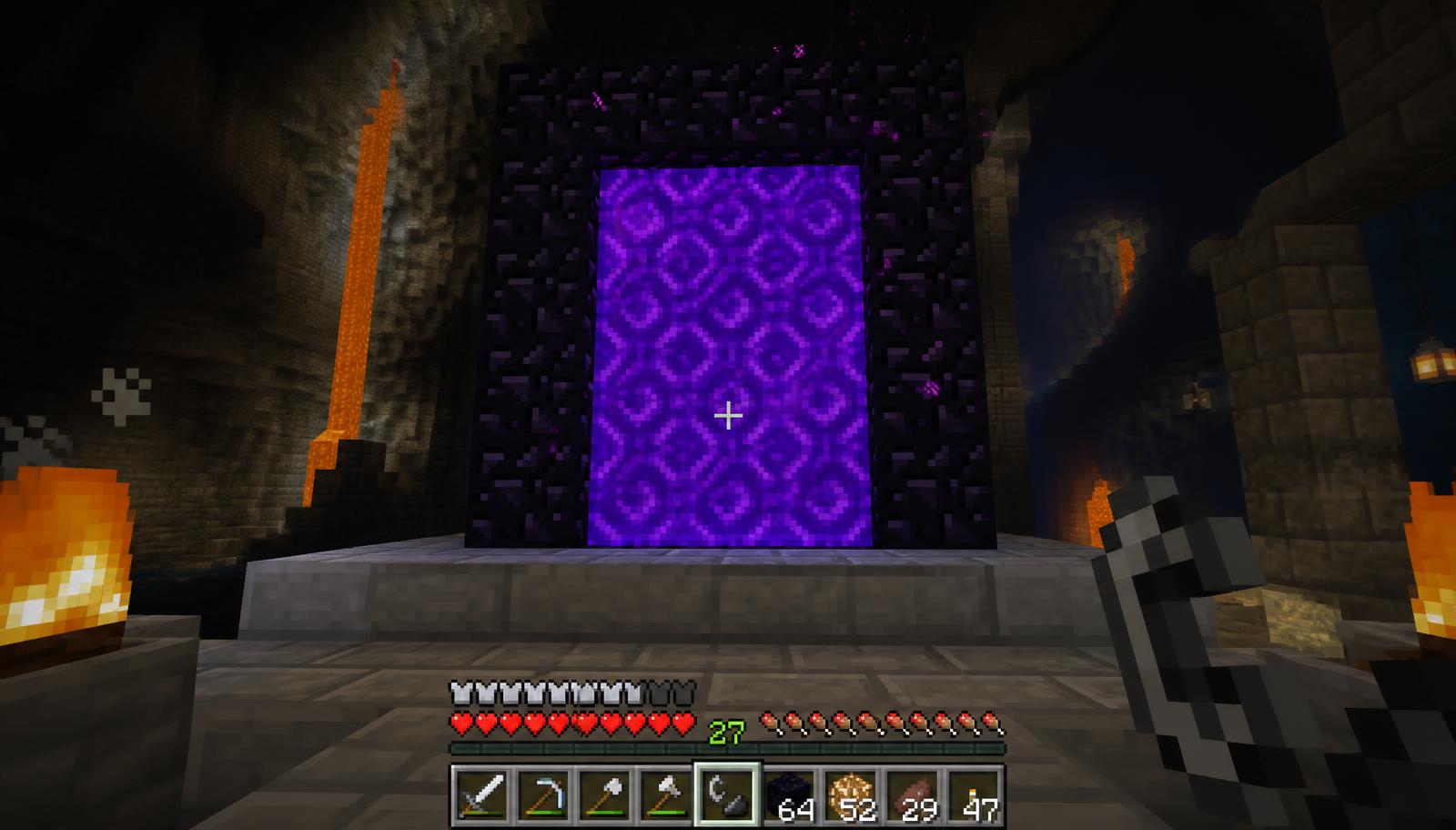
A nether portal is a vertical rectangle of obsidian with an air gap inside. The interior must be at least 2 blocks wide and 3 blocks tall, which means the outer frame measures 4 by 5.
- Clear a flat area 4 blocks wide and 5 blocks tall with air behind it.
- Place 2 obsidian on the ground side by side. This is the bottom edge and where you stand.
- Build 3 obsidian upward from each end of that bottom pair, forming two side pillars.
- Place 2 obsidian across the top to close the frame.
- Leave the four corner positions empty. The portal ignites and works exactly the same without them.
How to make a nether portal without diamonds
You do not need a diamond pickaxe at all. Obsidian forms whenever water touches a lava source block, and you can build the entire frame that way using a mould.
- Find a surface lava lake or a lava pool in a cave. Bring 2 buckets, a stack of cobblestone, and a shovel or pickaxe.
- Dig the frame shape into the ground as a mould, or build a cobblestone form in the air matching the 10-block layout.
- Pour a lava source into each frame position, one at a time, using a lava bucket refilled from the pool.
- Pour water over the lava. The lava source turns to obsidian instantly.
- Scoop the water back up and repeat until all 10 positions are obsidian.
Casting a portal this way is the standard early-game speedrun approach. It costs nothing but time and two buckets, and it lets you reach the Nether long before you find diamonds. If you are hunting obsidian pools instead, our structure finder and biome finder help you locate lava-rich terrain fast.
How to light a nether portal
The frame does nothing until you place fire inside it. Aim at the inside face of the bottom obsidian block, not the outside.
- Flint and steel — right-click the bottom inner obsidian. This is the standard method and the item has 64 uses.
- Fire charge — right-click the same spot. Crafted from 1 blaze powder, 1 coal or charcoal, and 1 gunpowder. Useful if you have no iron.
- Fire spread — any fire that reaches the inside of the frame will light it, including fire from a dispensed fire charge or a lightning strike.
- Lava — placing a lava source next to a flammable block adjacent to the frame can ignite it indirectly, though this is unreliable.
If nothing happens, the frame is almost certainly wrong. Count the interior: it must be at least 2 wide and 3 tall with pure air inside. Torches, snow layers, grass, or a single misplaced block in the opening will block ignition.
Portal size limits and wide portals
The minimum interior is 2 by 3, but the maximum is 21 by 21 interior, giving a 23 by 23 outer frame. Building wider than the minimum has real practical value.
- A 3-wide interior lets a horse walk through with you riding it.
- A wide portal accepts minecart rails, so you can run an automated item transfer line between dimensions.
- Large portals reduce the chance of getting stuck on the frame when you arrive under lag.
- Every extra block of interior width costs 2 more obsidian for the top and bottom edges.
Nether portal coordinates and linking
The Nether is compressed 8 to 1 against the Overworld. One block travelled in the Nether equals 8 blocks in the Overworld, which is why nether tunnels are the fastest long-distance transport in the game.
- Take your Overworld X and Z coordinates.
- Divide both by 8 to get the target Nether coordinates. Y stays roughly the same.
- Example: Overworld 800, 64, -400 becomes Nether 100, 64, -50.
- Build your Nether-side portal at those coordinates so the pair links reliably in both directions.
Our nether portal calculator does this conversion for you and shows the matching coordinates in both dimensions, which removes the arithmetic mistakes that cause mismatched portals.
Fixing portals that link to the wrong place
- Break the unwanted destination portal by mining one obsidian block from its frame. This forces the game to re-search on your next trip.
- Rebuild a fresh portal at the correctly converted coordinates and light it from the Overworld side first.
- Walk back through to confirm the return trip lands where you expect.
- Keep at least 128 Nether blocks, meaning 1024 Overworld blocks, between separate portal pairs so they never steal each other's links.
- Write your paired coordinates on a sign next to each portal. Future you will thank present you.
Staying alive on the other side
- Never take a bed into the Nether to sleep. Beds explode there. They are only useful as a deliberate bomb.
- Bring blocks. Ghast fireballs and a bad arrival spot over lava kill more players than any mob.
- Wear gold armour pieces so piglins stay neutral, or carry soul lanterns and soul torches to repel them.
- Fire Resistance potions turn the Nether from lethal to routine. See our potion recipes and brewing chart.
- Wall in the Overworld side of your portal so mobs do not follow you back through.
Once you are established, the Nether is where you gather blaze rods, ancient debris, and quartz. Our ancient debris finder shows the best Y level and branch pattern for netherite hunting.
Common nether portal mistakes
- Mining obsidian with an iron pickaxe. It breaks the block and gives nothing. Diamond or netherite only.
- Building the interior 2 by 2 instead of 2 by 3. The frame will never light.
- Trying to light the outside of the frame instead of the inside bottom block.
- Leaving a torch or snow layer inside the opening, which silently blocks ignition.
- Forgetting the divide-by-8 rule and building the Nether portal at Overworld coordinates, which puts your destination 8 times too far away.
- Sleeping in the Nether. The bed explodes and usually kills you.
Related guides and tools
Convert your coordinates with the nether portal calculator, plan netherite trips with the ancient debris finder, and read how to make obsidian in Minecraft for the fastest ways to stockpile frame blocks.