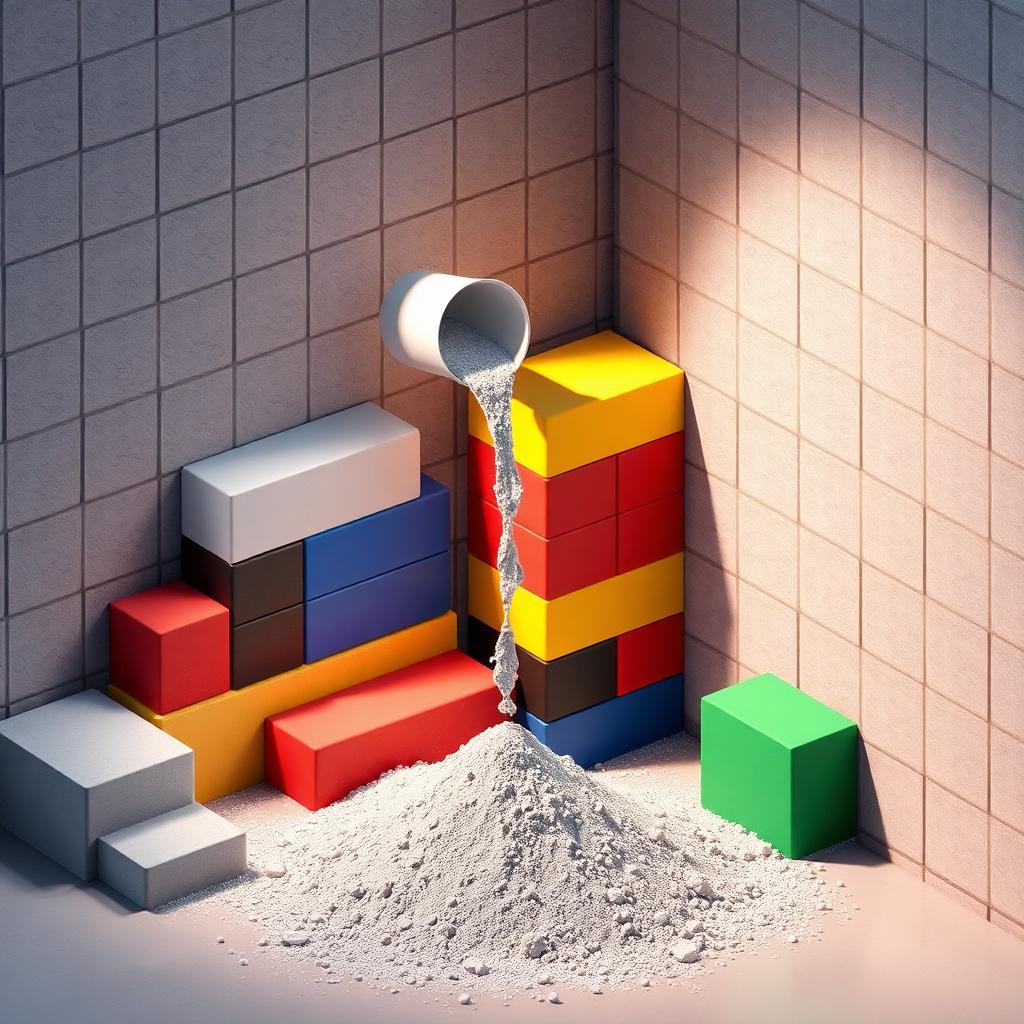
Short answer: to make concrete in Minecraft, craft concrete powder from 4 sand, 4 gravel, and 1 dye of your chosen color, then place or drop that powder next to a water source block. The powder hardens instantly on contact with water and becomes solid concrete — a vibrant, non-flammable building block that has become the go-to material for modern builds since it was added in the Update Aquatic (1.12 Java / 1.2 Bedrock).
Step 1: Craft concrete powder
Open a crafting table and fill the 3×3 grid with 4 sand, 4 gravel, and 1 dye. The recipe is shapeless — the position of each item does not matter, only the totals. Every craft outputs 8 concrete powder blocks of the color that matches the dye you used.
- Gather 4 sand — any variant of red or normal sand works and both produce identically colored concrete powder.
- Gather 4 gravel — dig it up on beaches, riversides, or the underside of Overworld cliffs.
- Pick your dye — 1 dye per craft. Bone meal makes white, ink sacs make black, lapis lazuli makes blue, and so on through all 16 colors.
- Combine all 9 items in the crafting grid. You will get 8 concrete powder of the matching color.
Concrete powder itself behaves like sand and gravel — it obeys gravity and falls when unsupported. That property is important for the fast-farm method further down.
Step 2: Harden the powder with water
Concrete powder only turns into solid concrete when it is directly touching a water source block. Flowing water works too, but rain, water bottles, cauldrons, and waterlogged blocks do not trigger the reaction.
- Place a bucket of water on the ground, then place concrete powder next to it — it hardens on the tick you place it.
- Drop concrete powder into a pool from above so it falls through a water source — it hardens mid-fall.
- Break the concrete with a wooden pickaxe or better to keep it. Breaking without a pickaxe drops nothing.
All 16 concrete colors and their dyes
Every dye in the game produces its matching concrete color. Use our color codes reference to map hex values to Minecraft dye colors when you are matching an external palette.
- White — bone meal (from skeletons or composting)
- Light gray — 1 white + 1 gray dye, or 1 white + 2 black
- Gray — 1 black + 1 white dye
- Black — ink sac from squid, or wither rose composted
- Red — rose bush or poppy
- Orange — orange tulip or 1 red + 1 yellow
- Yellow — sunflower or dandelion
- Lime — sea pickle smelted or 1 green + 1 white
- Green — cactus smelted
- Cyan — 1 blue + 1 green
- Light blue — blue orchid or 1 blue + 1 white
- Blue — lapis lazuli or cornflower
- Purple — 1 blue + 1 red
- Magenta — lilac, allium, or 1 purple + 1 pink
- Pink — pink tulip, peony, or 1 red + 1 white
- Brown — cocoa beans from jungle trees
Fastest way to make concrete in bulk
For any large build you will want hundreds or thousands of blocks. Manually placing and mining one block at a time is painful. This simple 1-wide water-drop farm converts full stacks in under a minute.
- Dig a 1×1×2 hole and place a water source in the top block so it flows downward.
- Below the water, dig one more block and place a hopper feeding into a chest.
- Stand above the water column and drop concrete powder stacks into it (Q on Java, tap-and-hold on Bedrock).
- The powder falls through water, hardens mid-fall, and the resulting concrete pops off as an item that the hopper collects.
Concrete vs wool vs terracotta
Choosing between the three main colored blocks comes down to durability, flammability, and vibrance.
- Concrete — hardness 1.8, non-flammable, saturated bright colors. Best for modern exteriors, roofs, and accent walls.
- Wool — hardness 0.8, highly flammable, softer pastel colors. Cheap early-game but a fire risk near lava or campfires.
- Terracotta — hardness 1.25, non-flammable, muted earth tones. Best for medieval, desert, and rustic builds.
If you are picking blocks for a build, run the palette through our interior designer to see how the three materials read side by side before committing.
Bedrock vs Java differences
The recipe and reaction are identical, but a handful of quality-of-life details differ.
- Java: powder placed directly next to a water source hardens instantly. Bedrock: same behavior since 1.16.
- Bedrock: falling powder that passes through water hardens into a concrete item — same as Java.
- Java only: waterlogged stairs and slabs do NOT harden touching concrete powder (waterlogging is not a water source for this reaction). Bedrock has the same limitation.
- Both editions: dispensers can shoot water to trigger the reaction, which is useful for full-auto farms.
Common uses and build ideas
- Modern houses — white and light gray concrete pair with dark oak trim and large glass panes for a clean contemporary look. Try our modern house generator for instant layouts.
- Roofs — orange, red, and terracotta-adjacent concrete colors read as ceramic tile at distance.
- Pixel art — the 16 saturated colors are ideal for map art and floor mosaics. Our pixel art generator converts any image to a concrete color map.
- Redstone contraption casings — non-flammable and non-conductive, so it is safe next to TNT and torches.
- Server spawns — bright concrete reads well in low-render-distance server browsers.