Bucket recipe in Minecraft (Java & Bedrock)
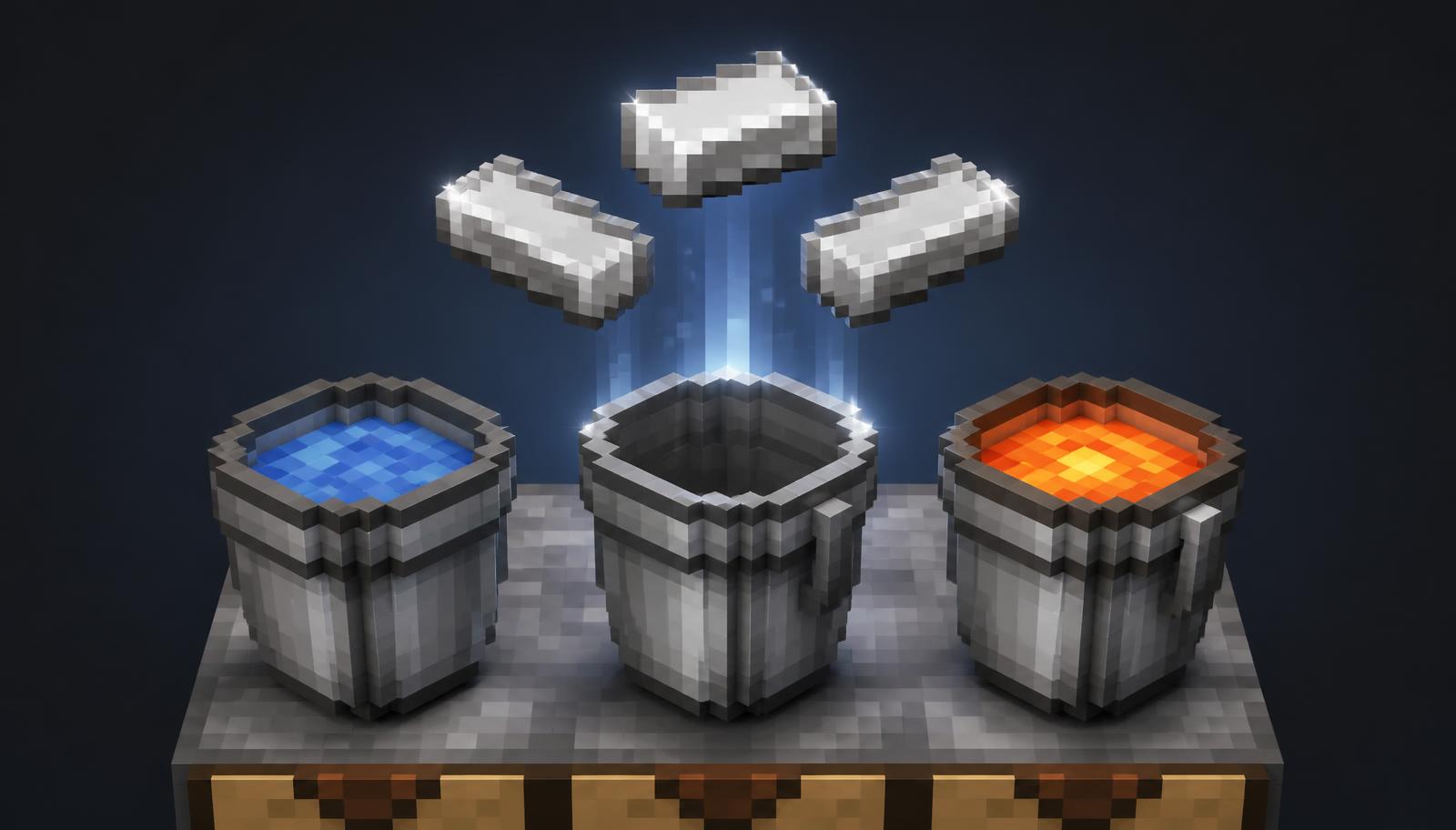
The bucket recipe has been unchanged since Alpha. You need 3 iron ingots and a crafting table — the 2x2 inventory grid is too small for the V shape, so a full 3x3 table is required.
Exact grid layout
- Row 1: empty — empty — empty
- Row 2: Iron Ingot — empty — Iron Ingot
- Row 3: empty — Iron Ingot — empty
One craft yields exactly 1 bucket. Iron nuggets, raw iron, and iron blocks do not work — you must smelt raw iron into ingots in a furnace or blast furnace first. The recipe is identical on Java, Bedrock, Pocket, Education, and console editions.
How to get iron fast for buckets
Three iron ingots is a small ask, but most players want a stack of buckets for farms and Nether trips. These are the fastest iron sources, ranked:
- Iron farms — a villager-and-golem iron farm produces 300 to 1,200 ingots per hour and is the only truly unlimited source. Plan the layout with our iron farm tool before you build.
- Deepslate mining — iron ore peaks around Y=15 and again near Y=232 in mountains. Branch mining at Y=-16 hits both deepslate iron and other ores.
- Exposed mountain veins — badlands and stony peaks expose large iron veins on the surface; a single mountainside can yield 20+ ingots with a stone pickaxe.
- Chest loot — village blacksmith chests, shipwreck supply chests, and dungeon chests routinely contain iron ingots and sometimes a pre-made bucket.
- Zombie drops — zombies and husks rarely drop iron ingots, and zombie villagers occasionally spawn holding an iron shovel or sword you can smelt down into nuggets.
Everything a bucket can hold
The empty bucket is a multi-tool. Right-click on the correct block or mob and it fills instantly:
- Water bucket — scoop any water source block. Used for farming, mob transport, fall damage cancelling, and lava-to-obsidian conversion.
- Lava bucket — scoop lava from a pool or cauldron. Doubles as the strongest furnace fuel in the game.
- Milk bucket — right-click a cow, mooshroom, or goat. Drinking it clears every status effect.
- Powder snow bucket — scoop powder snow from a cauldron or snowy peaks. Places a block that slows entities and extinguishes fire.
- Fish buckets — right-click a cod, salmon, tropical fish, pufferfish, axolotl, or tadpole to capture it alive and relocate it safely.
Buckets do not stack when full. An empty bucket stacks to 16, so plan inventory space around any project that needs bulk liquid transport.
How to build an infinite water source
This is the single most important bucket trick in Minecraft, and it means you only ever need one water bucket for the rest of a world.
- Dig a 2x2 hole one block deep (or a 1x3 trench).
- Place a water source in one corner, then a second source in the opposite corner.
- The middle block(s) become a renewing source block.
- Scoop from any source block forever — the flow immediately regenerates.
Infinite water works on Java and Bedrock alike, but it does not function in the Nether, where water evaporates instantly. Bring an ice block or a cauldron instead if you need Nether water.
Lava buckets as furnace fuel
A single lava bucket smelts 100 items — by far the best fuel-per-slot ratio in the game. For comparison, coal smelts 8, a coal block 80, a blaze rod 12, and a wooden plank just 1.5.
When a lava bucket is consumed in a furnace, the empty bucket is returned to the fuel slot rather than destroyed, so hopper-fed lava smelting arrays only lose the lava itself. A lava farm built on a dripstone-and-cauldron setup makes fuel genuinely renewable.
Milk buckets and status effects
Drinking milk removes all active status effects instantly. That makes it the emergency answer to poison from cave spiders, wither from wither skeletons, and bad omen before you enter a village.
The catch: milk removes good effects too. Do not drink it mid-fight if you are running Strength, Regeneration, or Fire Resistance. Milk is not craftable into anything except cake, and it cannot be stored in bottles.
Bucket tricks every player should know
- MLG water bucket — while falling, aim at the ground and right-click a water bucket at the last moment to cancel all fall damage.
- Lava-to-obsidian — pour water onto a lava source block to create obsidian for portals and blast-proof walls.
- Mob transport — water flows push mobs along channels, the backbone of nearly every mob farm design.
- Cave clearing — a water bucket poured down a lava-filled ravine turns the hazard into safe stone and obsidian.
- Farmland hydration — one water source hydrates farmland in a 4-block radius, so a single central bucket waters a 9x9 crop field.
- Fire suppression — water instantly extinguishes fire, and powder snow does the same while also freezing entities.
Common bucket mistakes
- Using the 2x2 grid — the V shape requires a full crafting table.
- Carrying only one bucket — infinite water needs two source placements, so a single bucket means extra trips.
- Taking water into the Nether — it evaporates the instant you place it. Bring ice or a cauldron.
- Placing lava near your storage — lava destroys dropped items and burns wooden chests nearby.
- Forgetting stack limits — full buckets never stack, so a lava-fuel run eats a whole hotbar.
Related tools and guides
Buckets underpin almost every automated build. Once you have a few, pair them with an iron farm layout for unlimited ingots, and read our obsidian guide to turn lava buckets into portal frames.