Paper is the quiet backbone of Minecraft progression — you need it for enchanted books, maps, fireworks for elytra flight, banner patterns, and the most reliable early-game emerald trade. This guide covers the exact recipe, the fastest sugar-cane farm design, every use for paper in 2026, and the villager trades that turn paper into infinite emeralds.
The paper recipe
Paper has one crafting recipe in both Java and Bedrock: three sugar cane placed horizontally in any row of a 3×3 crafting grid. Each craft yields three paper — a clean 1:1 conversion.
- Input: 3 sugar cane in a horizontal row (top, middle, or bottom row of the crafting grid).
- Output: 3 paper.
- Crafting table required: yes — the 2×2 inventory grid is too small.
- There is no shapeless variant. The three sugar cane must be in the same row.
Paper is not craftable from bamboo, wood, kelp, or any other plant despite what mods sometimes add. Vanilla Minecraft has exactly one source: sugar cane.
How to get sugar cane fast
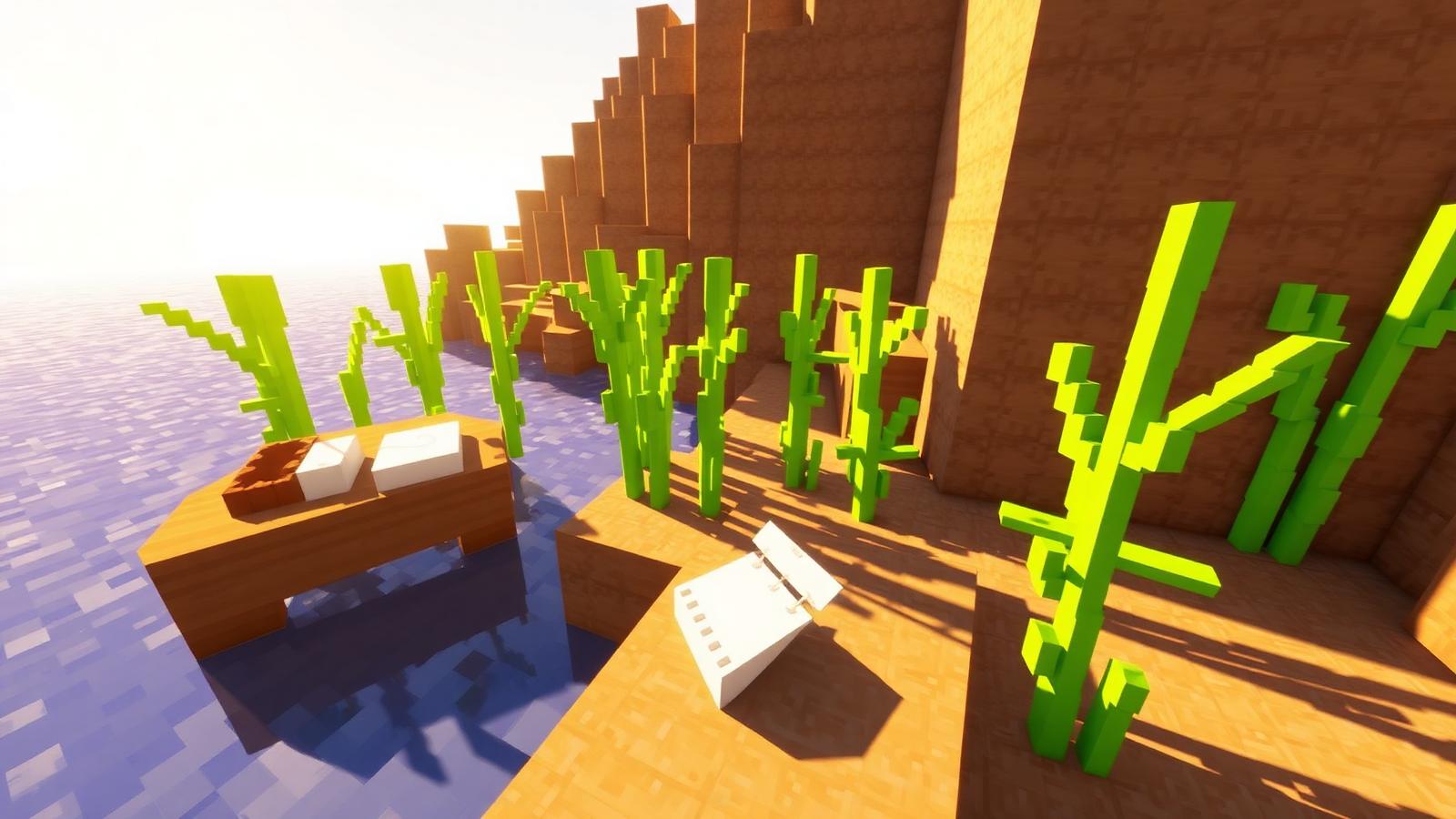
Sugar cane grows in the wild on riverbanks, swamp shores, beaches, and desert oases — anywhere sand, dirt, or grass meets water. To start a farm, you only need one starter cane. Break it fully (all three stalks if it's tall) and replant the bottom block near water at your base.
- Find any water tile — a lake, a river, or a bucket-dumped puddle counts.
- Place grass, dirt, sand, or podzol directly adjacent to the water on any of its four horizontal sides.
- Right-click the top of that block with sugar cane in hand. The starter stalk is now planted.
- Sugar cane grows one block every 8–20 minutes (average ~18 minutes for a full 3-stalk stack). It does NOT need light, so underground and nighttime farming both work.
- Harvest the top two blocks and leave the bottom stalk — the farm regrows without replanting.
The fastest sugar cane farm (250+ paper per hour)
The single best-value farm for a solo player is a manual 9×9 alternating-row design. It takes 15 minutes to build, uses no redstone, and yields ~750 sugar cane per hour of growth — enough for 250 paper without any tools beyond your fists.
Materials
- 40 dirt or grass blocks
- 9 water buckets (or 1 bucket + a source you don't mind emptying)
- 9 starter sugar cane (any amount, but you'll fill the farm faster with more)
- Torches for the surrounding walls if you're worried about mob spawns nearby
Layout
- Dig a 9×9 area one block deep.
- In rows 1, 3, 5, 7, and 9, place water source blocks along the full row (5 rows × 9 water = 45 sources).
- In rows 2, 4, 6, and 8, place dirt blocks (4 rows × 9 dirt = 36 farmland tiles).
- Plant sugar cane on every dirt tile. Each cane sits between two water rows, so every planting spot is legal.
- Fence in the perimeter and put torches on the fence posts.
To harvest: walk down each dirt row and swing at the second block of every stalk. Leave the bottom block. Full harvest takes about 90 seconds, and by the time you loop back to the first row it's regrown. This is the highest paper-per-minute design that doesn't need a piston timer or observer clock.
AFK piston farm (optional upgrade)
If you want a fully AFK farm, mount observers behind every sugar cane column, wire them to sticky pistons pointing at the top of the 3-stalk cane, and let a water stream flow into a hopper line. When the cane grows to full height, the observer fires, the piston pushes the top block off, and the item drops into hoppers. A 45-column AFK farm yields ~180 paper per hour with zero clicks. Use the redstone designer to lay out the observer/piston circuit cleanly.
What paper is used for
Paper is a crafting ingredient in more recipes than any other plant material. Every serious build eventually needs a stack.
Books and enchanting
3 paper + 1 leather = 1 book. Books feed the enchanting table (15 books = 15 bookshelves = level 30 enchants) and become enchanted books via anvil combinations. See the enchanting calculator for optimal XP planning.
Maps and cartography
8 paper + 1 compass = 1 empty locator map (Java), or 9 paper alone = 1 empty map (Bedrock). Use a cartography table to zoom out (each zoom doubles the area up to 4× the base) or to lock the map for permanent snapshots.
Fireworks
1 paper + 1–3 gunpowder = 1 firework rocket. Elytra flight is literally paper-limited — a single hour of survival flying eats through a stack of rockets, so an established paper farm is a prerequisite for aerial travel. Design your rockets in the firework generator.
Banner patterns and cartography items
Paper is a component of the Bordure Indented and Field Masoned banner patterns, plus every 'special' cartography-table paper craft. It's also used in the empty firework star recipe for larger displays. Plan complex banners in the banner generator.
Villager trades
Novice-level librarians buy 24 paper for 1 emerald. On a mature paper farm this is the single fastest early-game emerald route — a 45-column farm sustains ~10 emeralds every 6 minutes without touching cactus, wheat, or pumpkins.
Villager economy: paper into emeralds
Cure a zombie villager to lock in the Novice-tier discount and the paper→emerald trade becomes a permanent 12 paper for 1 emerald (down from 24). Combined with the 45-column AFK farm, that's roughly one emerald every 30 seconds of AFK time. This is why paper farms are usually the first infrastructure a survival base gets after storage and a bed.
Java vs Bedrock: paper differences
- Java empty map recipe: 8 paper + 1 compass in a crafting table (locator map). Bedrock: 9 paper for a basic empty map, OR 8 paper + 1 compass for a locator map.
- Sugar cane growth speed is very slightly faster on Bedrock in warm biomes (a hidden random-tick multiplier).
- Bedrock paper stacks to 64, same as Java — no differences here.
- Cartography table recipes are identical in both editions.
- Both editions treat bamboo as a NON-paper source. There is no vanilla path from bamboo to paper on either.
Common paper mistakes
- Planting sugar cane on stone or cobblestone. It won't grow — grass, dirt, coarse dirt, podzol, sand, or red sand only.
- Planting sugar cane one block away from water. It must be DIRECTLY adjacent horizontally to a water block.
- Trying to bone-meal a stalk. Doesn't work in vanilla.
- Harvesting the bottom stalk. This forces you to replant every cycle — always break at the second block up.
- Using paper as fuel. It's not fuel, and it can't be composted, either. Store it or trade it.
- Assuming books need enchanted paper. Plain paper + plain leather = a plain book. Enchantments come from the enchanting table, not the ingredients.
Where paper fits in a full base
A mature Minecraft base has three farms running in the background: food, iron, and paper. Paper is what turns everything else into progression — the enchanted-book library, the map wall, the fireworks bin next to the elytra chest, and the villager trading hall. Get the 9×9 farm running on day 3, wire in the AFK upgrade around day 10, and by week 2 you'll never think about paper again — you'll just have it.